Guide
Wolf vs Viking Gas Cooktop: Burners, Reliability, Warranty
A fair Wolf vs Viking gas cooktop comparison: burner output, simmer control, cleanup, common failures, warranty terms and typical repair ranges.
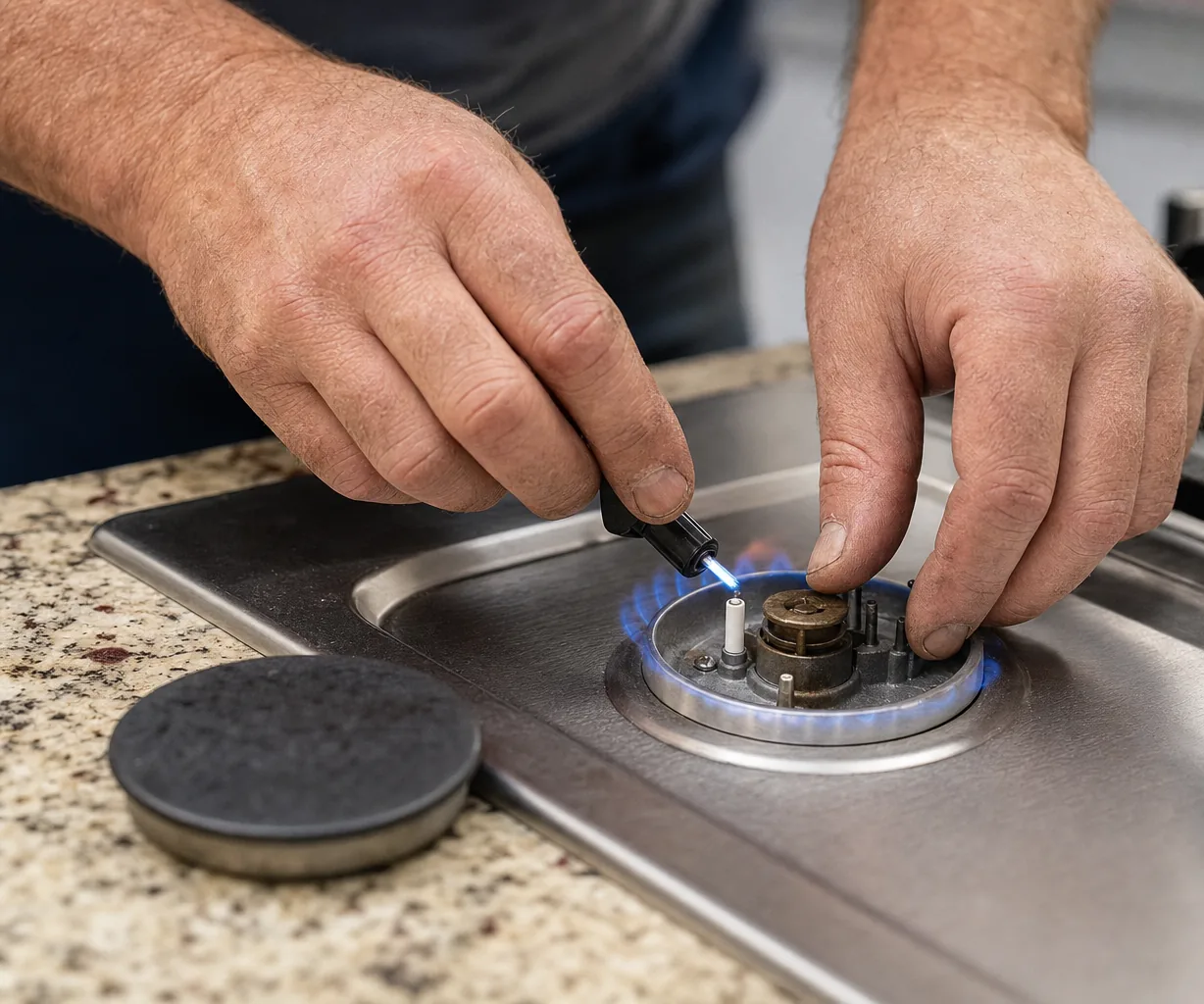
Wolf gas cooktops top out at an 18,000 Btu large burner on the 24-, 30- and 36-inch transitional and professional models (20,000 Btu on the 36-inch contemporary), while Viking’s 7 Series ranges and rangetops put 23,000 BTU burners across the front. In short, Viking leads on peak heat, Wolf is designed around fine low-heat control, and in years three through five Viking supplies gas burner parts only, leaving out ignition systems, bases and caps.
Neither brand is a bad buy. Both use sealed burners and spark ignition, and both wear in the same few places. The better choice depends on how you cook and what upkeep you expect.
How do Wolf and Viking burners compare on power and simmer?
On Wolf 24-, 30- and 36-inch transitional and professional gas cooktops, the lineup is an 18,000 Btu large burner, a 12,000 Btu medium burner and 9,200 Btu small burners. The 36-inch contemporary raises the large burner to 20,000 Btu, and the 15-inch unit pairs one 12,000 Btu and one 9,200 Btu burner. Wolf’s burners are dual-stacked: an upper ring of ports for high heat and a lower ring for the bottom of the dial, so sauces and melting chocolate hold a steady, gentle heat.
Viking publishes higher peaks. The 7 Series Elevation Burners put a 23,000 BTU burner across the front of every width, with several 15,000 BTU burners and one 8,000 BTU burner at the back. 5 Series gas ranges use 15,000 BTU sealed burners (12,500 BTU on propane), and select models add a TruPower Plus front-right burner at 18,500 BTU on natural gas or 16,600 BTU on propane. These figures come from Viking’s range and rangetop literature, so confirm the burner mix on the exact cooktop you are pricing.
| Line | Strongest burner | Other burners | Best for |
|---|---|---|---|
| Wolf 24”, 30”, 36” transitional/professional | 18,000 Btu | 12,000 Btu, 9,200 Btu | Control from sear to simmer |
| Wolf 36” contemporary | 20,000 Btu | See spec sheet | A flush look, bigger top burner |
| Wolf 15” gas | 12,000 Btu | 9,200 Btu | A second cooking zone |
| Viking 7 Series | 23,000 BTU front | 15,000 and 8,000 BTU rear | Fast boils, wok heat |
| Viking 5 Series | 18,500 BTU TruPower Plus (select) | 15,000 BTU | One power burner |
Extra Btu at the top matters if you boil big pots or cook in a wok often; for sauces, eggs and fish, simmer control matters more.
Which cooktop is easier to live with day to day?
Both brands use sealed burners, so spills stay on top instead of dropping into the burner box, and both use heavy cast-iron grates. The differences:
- Viking’s 7 Series Elevation Burners lift the ports above the surface, so boil-overs drain away instead of baking on.
- Wolf’s stacked burners have two rows of ports to keep clear, and each cap must sit flat for an even flame.
Wipe spills once the top cools, let the burner area dry before relighting, and seat each cap squarely. Water and cleaner near the igniter commonly cause clicking or slow lighting.
Which brand is more reliable over time?
The failure patterns are more alike than the marketing suggests. Sealed-burner gas cooktops tend to need service at the spark igniters and spark module, the gas valves behind the knobs, and burner caps or bases that warp or clog. Cleaning habits affect reliability as much as the badge.
| Symptom | Likely cause | What you can check | When to call a technician |
|---|---|---|---|
| Nonstop clicking | Moisture on the igniter or a stuck knob switch | Let it dry for a few hours, caps seated | Clicking continues once dry |
| One burner won’t light | Clogged ports, misaligned cap, worn electrode | Clear ports with a paper clip, reseat the cap | No spark at that burner |
| No spark anywhere | Power or spark module | Check the breaker and plug | Power is fine, still no spark |
| Yellow or uneven flame | Cap off center, dirty ports, wrong gas setup | Reseat and clean; confirm natural gas or propane | Flame stays yellow or lifts |
| Smell of gas | Leak at a fitting or valve | Knobs off, no flames or switches; leave and call the gas utility | After the utility clears it |
How do the Wolf and Viking warranties compare?
Viking’s terms are tiered. In years three through five it supplies parts only, with the owner paying labor and shipping, for gas burners (not ignition systems, bases or caps), plus electric elements, induction coils and a short list of other parts. So ignition parts, which are among the parts that wear, sit outside that later coverage.
For Wolf, read the warranty document that came with your cooktop before scheduling anything; terms can change between model years, so if you are buying in 2026, compare both brands’ current documents side by side.
Alpine Wolf Appliance Repair is an independent service, not manufacturer-authorized, so if your cooktop is still inside a covered period, check with the manufacturer first.
What does it cost to own and repair either one?
Retail prices vary with dealer, width and burner layout, so compare quotes for the same width. Repair costs land close together for both brands. These are typical ranges; the firm quote is given on site after diagnosis, and the service call is credited toward the repair.
| Repair | Typical range |
|---|---|
| Diagnostic / service call | $95–$149 |
| Cooktop repair | $200–$750 |
| Gas valve / spark module | $300–$650 |
See repair pricing and how a cooktop repair visit works.
How do you read the model number before you buy or book service?
In Wolf model numbers, CG marks a gas cooktop, CI induction, CE electric and MM the multi-function cooktop, and a letter after the prefix marks Transitional, Professional or Contemporary styling. A model ending in -LP runs on liquid propane, and SRT is Wolf’s sealed burner rangetop.
On Viking 7 Series rangetops the model and serial label sits under the control panel; on 7 Series ranges, open the oven door and look under the control panel. Have those numbers ready when you call.
Which one fits the way you cook?
- Choose Wolf if you braise, make sauces or want every burner to step down evenly.
- Choose Viking if you want maximum front-burner heat and raised ports for easier cleanup.
- Either way, match the gas type and cutout size, and check years three through five of the warranty.
Alpine sits on top of the Palisades, and many homes here are large custom builds with room for a 36-inch cooktop plus a second cooking zone. We service Wolf and Viking gas cooktops in Alpine, Cresskill, Closter, Tenafly and Demarest; call (914) 449-5646.
Frequently asked questions
Is a Wolf or Viking gas cooktop more expensive to repair?
Repair costs are similar, because the parts that wear are the same kinds of parts. Typical ranges are $200–$750 for cooktop repair and $300–$650 for a gas valve or spark module, with the firm quote given on site after diagnosis.
Does Viking have more BTUs than Wolf?
On paper, yes: Viking’s 7 Series front burners reach 23,000 BTU, while Wolf’s largest gas cooktop burner is 20,000 Btu on the 36-inch contemporary. Wolf answers with stacked burners built for steady low heat.
Does Viking’s warranty cover igniters in years three through five?
No. In that period Viking supplies parts only for gas burners, and ignition systems, bases and caps are excluded.
Why does my gas cooktop keep clicking after cleaning?
Moisture near the igniter is the usual cause. Let it dry for a few hours; if the clicking continues, a knob switch or the spark module may need service.